Newsletter Subscribe
Enter your email address below and subscribe to our newsletter


Discover how women's roles in entertainment are evolving in 2026. Explore behind-the-scenes representation, streaming opportunities, industry biases, and the impact of female creators.
Women hold less than a quarter of key behind-the-scenes roles in top films, even as their on-screen presence grows. This stark gap reveals how much work remains to achieve true equity in entertainment. The industry faces persistent biases, from sexist film criticism to hiring practices that limit opportunities for female creators. Yet streaming platforms and female-led projects are reshaping the landscape, creating new pathways for women in directing, writing, and producing. This article unpacks the data behind these disparities, explores the barriers women face, and highlights the progress emerging across film, television, and digital media.
| Point | Details |
|---|---|
| Behind the scenes gap | In 2025 top 250 films women held 23 percent of key behind the scenes roles, with directors at 13 percent and cinematographers at 7 percent, highlighting persistent male dominance in decision making. |
| Structural barriers persist | Hiring networks, culture norms, and caregiving demands limit women’s access to career opportunity and leadership across film, television, and digital media. |
| Streaming opening doors | Streaming platforms and female led projects are reshaping the landscape by offering more opportunities in directing, writing, and producing than traditional models. |
| Streaming gains in TV | The 2024-25 season saw women creators reach 36 percent on streaming and women directors helm 32 percent of episodes, signaling progress on platforms but still lower on broadcast networks. |
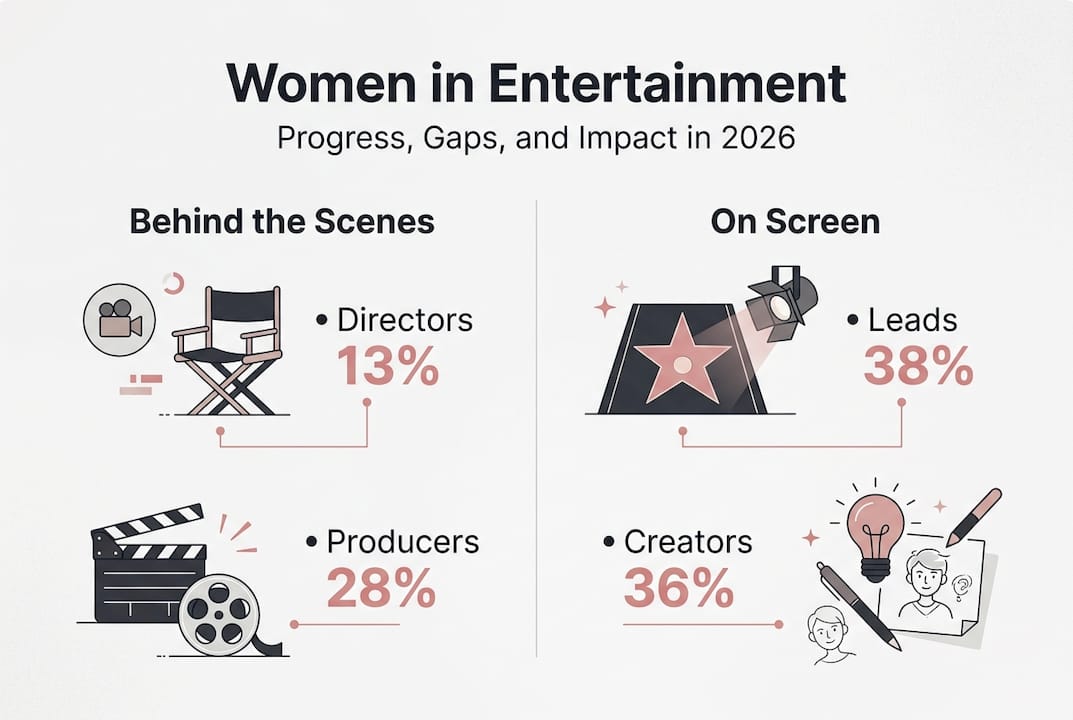
The numbers tell a sobering story about who controls the creative vision in Hollywood. In 2025’s top 250 films, women comprised just 23% of key behind-the-scenes roles, revealing how male-dominated the industry remains at decision-making levels. This disparity becomes even sharper when you break down specific positions.
Directors represent the most visible leadership gap, with women holding only 13% of directing positions on major films. Writers fare slightly better at 20%, while producers reach 28%, the highest representation among key roles. Cinematographers face the steepest barriers, with women occupying a mere 7% of these technical leadership positions. These statistics matter because directors, writers, producers, and cinematographers shape every aspect of storytelling, from narrative perspective to visual style.
| Role | Women’s Representation | Gap to Parity |
|---|---|---|
| Directors | 13% | 37 percentage points |
| Writers | 20% | 30 percentage points |
| Producers | 28% | 22 percentage points |
| Cinematographers | 7% | 43 percentage points |
| Editors | 18% | 32 percentage points |
Several structural barriers maintain these gaps. Hiring practices often rely on networks and relationships built in male-dominated spaces, creating a self-perpetuating cycle. Industry culture normalizes long hours and inflexible schedules that disproportionately affect women, especially those with caregiving responsibilities. Studios also tend to assign bigger budgets and higher-profile projects to male directors, limiting women’s access to career-advancing opportunities.
The most underrepresented roles share common characteristics:
Some studios are implementing targeted strategies to close these gaps. Warner Bros. and Disney have launched director development programs specifically for women and underrepresented creators. Netflix requires diverse candidate slates for key creative positions. Production companies increasingly track representation metrics and tie executive compensation to diversity goals. Understanding the role of women in media helps contextualize these industry-wide challenges.
Pro Tip: When choosing what to watch, actively seek out films directed or written by women. Your viewing choices send market signals that influence studio investment decisions and create demand for female-led projects.
Television and streaming platforms tell a more optimistic story about women’s creative influence. The 2024-25 season marked a historic high, with women creators reaching 36% on streaming services compared to just 24% on broadcast networks. This gap reveals how newer platforms embrace different hiring practices and take more creative risks than traditional television.
Streaming services also employ women directors at significantly higher rates. Female directors helmed 32% of streaming episodes versus only 18% of broadcast episodes in the same season. This 14-percentage-point gap demonstrates how platform structure affects opportunity. Streaming shows typically have shorter seasons and more diverse production models, allowing showrunners greater control over hiring decisions.
| Platform Type | Women Creators | Women Directors | Female Major Characters |
|---|---|---|---|
| Streaming | 36% | 32% | 49% |
| Broadcast | 24% | 18% | 44% |
| Cable | 28% | 22% | 46% |
The connection between female creators and on-screen representation creates a powerful multiplier effect. Shows with women creators consistently feature more complex female characters, diverse storylines about women’s experiences, and nuanced portrayals that challenge stereotypes. Major characters on streaming shows reached 49% female, approaching parity and reflecting how creator diversity translates to character diversity.
Female representation on screen delivers concrete benefits:
This streaming advantage extends beyond pure numbers. Platforms like Netflix, Hulu, and Amazon Prime greenlight projects that traditional networks might consider too risky or niche. Shows created by women often explore themes like motherhood, career ambition, female friendship, and sexuality with depth rarely seen in broadcast television. These shows also tend to hire more women across all production roles, from writers’ rooms to post-production teams. Exploring women creators in media reveals how this creative leadership shapes entire industries.
Pro Tip: Follow female showrunners and creators on social media to discover new projects before they hit mainstream attention. You’ll find hidden gems and support emerging voices who need audience advocacy to secure future seasons.
Despite measurable progress, women in entertainment confront persistent biases that undermine their careers and limit opportunities. Film criticism reveals particularly troubling patterns. A comprehensive study found that reviews contain 44% more benevolent sexism and 149% more hostile sexism when discussing female-led casts compared to male-led films. These biased reviews shape public perception and box office performance, directly affecting women’s career trajectories.
Benevolent sexism appears superficially positive but reinforces limiting stereotypes. Critics praise actresses for their beauty, charm, or emotional vulnerability rather than their technical skill or range. They describe female characters as “strong” when they simply perform basic competence, applying standards never required of male characters. This seemingly complimentary language actually constrains how audiences and industry decision-makers perceive women’s capabilities.
Hostile sexism manifests more overtly. Reviews dismiss female-driven stories as “niche” or “for women,” implying limited commercial appeal. Critics scrutinize actresses’ appearances, ages, and personal lives in ways they never apply to actors. They attribute a film’s success to male co-stars or directors while blaming failures on female leads. This double standard creates an environment where women must work harder for less recognition.
Film reviews reveal 44% more benevolent sexism and 149% more hostile sexism for female-led casts, directly impacting careers and longevity in an industry where perception shapes opportunity.
Stereotypes extend beyond criticism into hiring and casting decisions:
These biases compound over time, shortening women’s careers and limiting their industry influence. An actress who faces age discrimination at 40 loses 20-30 potential working years compared to male peers. A director labeled “difficult” for advocating for her vision gets fewer opportunities while male directors with identical behavior face no consequences. Public perception, shaped by biased media narratives, reinforces these patterns by accepting age gaps, appearance standards, and limited roles as normal rather than discriminatory. Understanding female stereotypes impact helps contextualize how these biases operate across entertainment sectors.
Female leadership behind the camera creates measurable ripple effects throughout production. Projects with women creators demonstrate dramatically different hiring patterns. Films with female creators employ 42% women directors compared to just 20% on projects led by men. The gap widens further for writers, with female-led projects hiring women for 62% of writing positions versus 20% on male-led productions.
This hiring advantage stems from several interconnected factors. Female producers and creators actively combat the network effects that typically exclude women from opportunities. They recognize talent in people who don’t fit traditional industry molds. They create production environments that accommodate diverse working styles and life circumstances. Most importantly, they understand that diverse teams produce better creative work and reach broader audiences.
Ways female producers foster inclusive hiring:
The impact extends to technical and creative roles where women remain severely underrepresented. Female producers actively recruit women cinematographers, sound designers, and visual effects supervisors, providing them with high-profile projects that build their portfolios and industry reputations. This intentional hiring creates a virtuous cycle where successful women in technical roles become mentors and advocates for the next generation.
Female leadership also challenges traditional production norms that disadvantage women. Shows run by female creators feature more reasonable working hours, reducing the burnout that drives women from the industry. They normalize discussions about work-life balance and mental health. They create spaces where women can advocate for themselves without being labeled “difficult” or “unprofessional.”
Increasing women in producer and director roles represents the most effective strategy for driving broader industry change. These leadership positions control budgets, hiring decisions, and creative direction. When women occupy these roles in sufficient numbers, they transform industry culture from within, making entertainment more equitable and inclusive for everyone. Developing women leadership essentials becomes crucial for sustaining this momentum.
The entertainment industry’s evolution reflects broader cultural shifts toward gender equity and female empowerment. Understanding these dynamics helps you make informed choices about the media you consume and support. WomanEdit offers extensive resources exploring how women shape culture, influence trends, and build power across entertainment and lifestyle sectors.
Discover practical insights in our women empowerment guide that connects entertainment representation to everyday choices. Learn how celebrity culture influences trends and shapes your personal style decisions. Explore success stories like Margot Robbie’s Barbie and LuckyChap slate that demonstrate how female producers transform Hollywood. These resources provide actionable knowledge for supporting women’s creative work and understanding the cultural forces shaping modern entertainment.
Women achieve highest representation as producers, comprising 28% of producer positions on top films. Writers follow at 20%, while directors reach only 13%. Cinematographers face the steepest barriers at just 7%, making it the most male-dominated key creative role in major film production.
Streaming platforms provide significantly more opportunities, with women creators reaching 36% compared to 24% on broadcast television. Female directors helm 32% of streaming episodes versus only 18% on broadcast. This gap reflects how newer platforms embrace different hiring practices and take more creative risks than traditional networks.
Women encounter both benevolent and hostile sexism throughout their careers. Film reviews contain 149% more hostile sexism toward female-led casts, affecting box office performance and career opportunities. Age discrimination, appearance standards, and motherhood penalties create additional barriers that shorten careers and limit advancement compared to male peers.
Female creators directly influence who appears on screen and how stories get told. Shows with women creators feature 49% female major characters compared to lower percentages on male-led projects. These creators develop more complex female characters, explore diverse women’s experiences, and challenge limiting stereotypes that dominate traditional entertainment narratives.
Actively choose films and shows directed or created by women, as viewing numbers influence studio investment decisions. Follow female creators on social media to discover new projects and amplify their work. Discuss and recommend female-led content within your networks. Support streaming platforms and studios that prioritize gender equity in hiring and production practices.