Newsletter Subscribe
Enter your email address below and subscribe to our newsletter

Enter your email address below and subscribe to our newsletter

Women empowerment means rights, confidence, and opportunities for women. Explore key forms, real-life impact, and common myths.
Stepping into your power means more than breaking the rules of fashion or following the latest trends—it’s about discovering what true confidence looks like in every part of your life. For young women everywhere, the path to feeling seen, heard, and independent is shaped by more than headline moments. Women’s empowerment is about making real choices, building self-worth, and claiming space in a world dominated by old expectations. This guide spotlights the core ideas and strategies that can help you turn inspiration into lasting confidence and opportunity.
| Point | Details |
|---|---|
| Empowerment Principles | Women’s empowerment involves gaining autonomy and control in personal and professional lives. It is driven by leadership commitment, access to resources, and equitable environments. |
| Types of Empowerment | Key dimensions include social, economic, political, educational, and psychological empowerment, each crucial for fostering women’s growth. |
| Barriers to Empowerment | Common obstacles include gender stereotypes, limited access to education, and economic marginalization, requiring multifaceted solutions. |
| Impact of Empowerment | Empowerment leads to enhanced decision-making, economic independence, and overall societal progress while challenging existing inequalities. |
Women’s empowerment represents a transformative process of enabling women to gain power, autonomy, and control over their personal and professional lives. At its core, this concept goes beyond mere equality – it’s about creating genuine opportunities for women to make strategic choices, develop self-confidence, and actively shape their individual and collective futures.
The United Nations has articulated several key principles that define women’s empowerment, which include:
Fundamental components of women’s empowerment include strategic personal choices and resource access. This means creating environments where women can:
Effective empowerment requires a holistic approach that addresses systemic barriers. It’s not just about individual achievements, but transforming broader societal frameworks that have historically limited women’s potential. The process involves comprehensive strategies targeting education, economic opportunities, legal rights, and social recognition.
Pro tip: Start by identifying and challenging subtle gender biases in your personal and professional environments to contribute to meaningful empowerment.
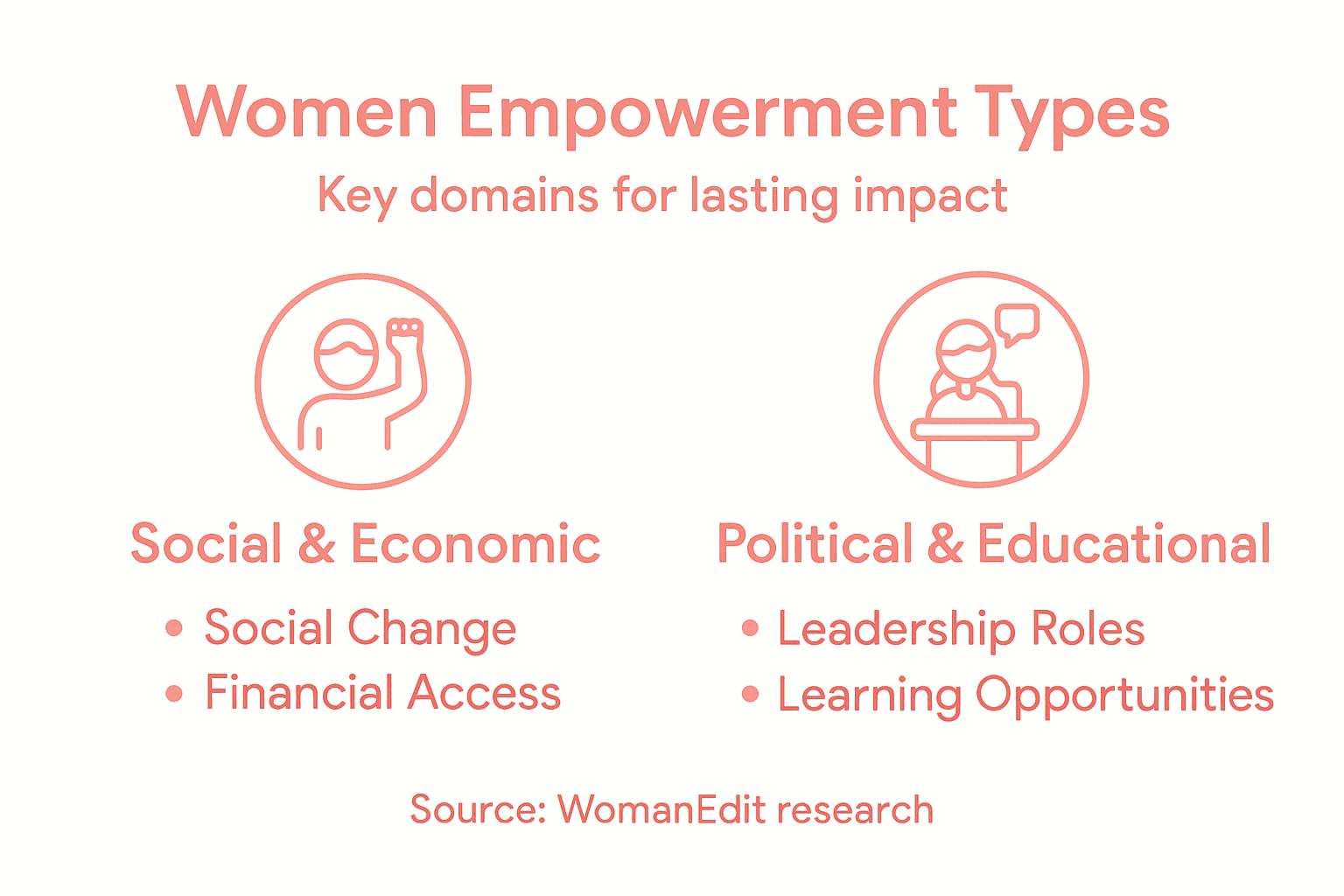
Women’s empowerment is a multifaceted concept that encompasses several critical dimensions, each addressing unique challenges and opportunities for women’s growth and development. Diverse domains of empowerment span social, economic, political, educational, and psychological spheres, creating a comprehensive framework for advancing gender equality.
Key types of women’s empowerment include:
Social empowerment focuses on transforming deeply ingrained social structures that limit women’s potential. This involves challenging traditional gender roles, combating discrimination, and creating supportive community environments that recognize women’s inherent value and capabilities.

Economic empowerment is crucial for women’s independence. Multiple domains of women’s opportunities include financial literacy, entrepreneurship, equal workplace opportunities, and economic decision-making power. By gaining economic autonomy, women can dramatically reshape their personal and professional trajectories.
Political empowerment requires increasing women’s representation in leadership roles, from local government to national policy-making. This means creating pathways for women to participate meaningfully in political processes, ensuring their perspectives and experiences are represented in critical decision-making platforms.
Educational empowerment remains a foundational element, providing women with knowledge, skills, and critical thinking abilities. Access to quality education enables women to challenge systemic barriers, develop professional competencies, and pursue diverse career opportunities.
Psychological empowerment involves developing inner strength, self-confidence, and personal agency. This type of empowerment helps women recognize their inherent worth, challenge internalized limitations, and pursue their goals with resilience and determination.
Pro tip: Identify and systematically work on developing skills across these different empowerment domains to create holistic personal growth and impact.
Here’s a summary comparing the main types of women’s empowerment and their unique benefits:
| Empowerment Type | Core Focus | Practical Benefit |
|---|---|---|
| Social Empowerment | Challenging societal norms | Greater community acceptance |
| Economic Empowerment | Financial literacy and independence | Increased career and income options |
| Political Empowerment | Leadership and representation | Influence on policy and decisions |
| Educational Empowerment | Access to quality learning | Better job and skill potential |
| Psychological Empowerment | Building self-worth and resilience | Stronger confidence and motivation |
Sustainable women’s empowerment requires a comprehensive approach that addresses multiple interconnected dimensions of personal and systemic challenges. Three critical pillars of empowerment include agency, resources, and institutional context, which together create a robust framework for meaningful transformation.
Key elements driving lasting empowerment encompass:
Personal agency represents the foundational element of empowerment. This involves developing women’s capacity to make independent choices, set personal goals, and pursue them with confidence and strategic planning. Agency enables women to challenge existing power structures and create meaningful change in their lives.
Comprehensive policy reforms are crucial in addressing systemic barriers. These reforms must target multiple domains, including:
Economic empowerment plays a transformative role by providing women with financial independence and decision-making power. When women gain control over economic resources, they can more effectively challenge existing social hierarchies and create sustainable pathways for personal and community advancement.
Institutional change remains critical, requiring deliberate efforts to dismantle discriminatory structures and create environments that genuinely support women’s growth and potential. This involves reforming workplace policies, educational systems, and social norms that have historically limited women’s opportunities.
Pro tip: Systematically identify and challenge barriers in your personal and professional environments, focusing on building skills and creating supportive networks.
Women’s empowerment confronts complex barriers that extend far beyond surface-level challenges. Persistent obstacles encompass multiple systemic dimensions including cultural norms, structural inequalities, and deeply entrenched social perceptions that limit women’s potential and opportunities.
Key barriers to women’s empowerment include:
Gender stereotypes represent one of the most significant barriers to genuine empowerment. These persistent misconceptions create artificial limitations that suggest women are less capable in leadership, technological, and professional domains. Such stereotypes discourage women from pursuing ambitious goals and reinforce systemic inequalities.
Multifaceted approaches are necessary to dismantle these complex barriers. This requires simultaneous efforts across several critical domains:
Economic barriers remain particularly challenging, with women often experiencing reduced access to financial resources, credit, and entrepreneurial opportunities. These economic restrictions directly impact women’s ability to achieve independent decision-making power and personal growth.
Misconceptions about empowerment frequently emerge from deeply ingrained societal beliefs. Many individuals mistakenly view women’s empowerment as a zero-sum game that threatens traditional power structures, rather than recognizing it as a collaborative approach to creating more balanced and just social systems.
Pro tip: Actively challenge stereotypes by consistently demonstrating competence, supporting other women, and refusing to internalize limiting narratives about your potential.
This table highlights common barriers to empowerment and strategies to overcome them:
| Barrier | Impact on Women | Overcoming Strategy |
|---|---|---|
| Gender Stereotypes | Limits leadership chances | Promote diverse role models |
| Economic Marginalization | Restricts financial growth | Expand access to capital and jobs |
| Limited Education | Reduces opportunity access | Invest in targeted scholarships |
| Institutional Discrimination | Hinders equal participation | Reform workplace and legal policies |
Women’s empowerment transforms individual lives and entire societal structures through profound, interconnected changes. Personal and collective development emerge when women gain the ability to make strategic life choices, challenge existing limitations, and actively participate in social, economic, and political processes.
Key transformative impacts of empowerment include:
Economic independence represents a critical dimension of empowerment. When women gain financial resources and career opportunities, they can:
Sustainable development fundamentally depends on women’s comprehensive empowerment. This means creating environments where women can access education, healthcare, economic resources, and political representation without systemic barriers.
Psychological transformation occurs alongside these practical changes. Empowerment enables women to rebuild self-confidence, challenge internalized limitations, and reimagine their potential beyond traditional societal expectations. This internal shift is often as significant as external opportunities.
The ripple effects of women’s empowerment extend far beyond individual experiences. Empowered women drive social progress, challenge discriminatory systems, and create more inclusive, equitable communities that benefit everyone.
Pro tip: Cultivate a supportive network of empowered women who can provide mentorship, challenge your limitations, and celebrate your achievements.
Understanding the complexities of women’s empowerment is the first step toward breaking down barriers like economic limitations, societal stereotypes, and restricted opportunities. This article highlights the importance of building personal agency, confidence, and access to resources—challenges that many women face daily in both personal and professional environments. At WomanEdit, we go beyond information by inspiring you with stories, style updates, and wellness insights designed to boost your confidence and keep you connected to a community of empowered women.
Explore how you can turn awareness into action today by visiting WomanEdit for engaging content on lifestyle, empowerment, and wellness. Join us now to discover practical tips and uplifting stories that help you challenge stereotypes and embrace your full potential. Start your empowerment journey by reading more at Women Empowerment Insights and experience exclusive content that supports your growth every step of the way.
Women empowerment is a transformative process that enables women to gain power, autonomy, and control over their personal and professional lives, creating opportunities to make strategic choices and build self-confidence.
Women empowerment matters because it challenges societal norms, promotes equality, improves economic stability, and enhances health and education outcomes for women, ultimately benefiting society as a whole.
The key principles of women empowerment include leadership commitment to gender equality, access to health and safety resources, equitable educational and professional development opportunities, and community advocacy and support.
Individuals can contribute to women’s empowerment by challenging gender biases, supporting women’s leadership, promoting equitable workplace practices, and advocating for policies that protect women’s rights.
Source: Editorial Use | Image: Editorial Use