Newsletter Subscribe
Enter your email address below and subscribe to our newsletter

Enter your email address below and subscribe to our newsletter

Discover what empowerment truly means for women beyond hustle culture. Learn practical steps to build confidence, emotional control, and authentic agency in your life.
You’ve probably heard empowerment thrown around everywhere, from Instagram captions to corporate buzzwords. But what does it actually mean for you as a woman navigating life’s challenges? The truth is, empowerment isn’t about hustling harder or checking off success boxes. It’s a deeply personal journey involving emotional control, meaningful choices, and genuine confidence. This guide cuts through the noise to show you what real empowerment looks like and how to build it in your own life, step by practical step.
| Point | Details |
|---|---|
| Multidimensional empowerment | Empowerment is a multidimensional journey that gives you control over health decisions, finances, education and career, and your relationships and voice in your community. |
| Core psychological elements | Core psychological elements include meaning, competence, self determination and impact that together build genuine confidence and motivation. |
| Emotional regulation tools | Emotional regulation and supportive networks are practical tools that help you manage feelings, set boundaries, and sustain progress. |
| Hustle versus sustainability | Empowerment is not about hustling harder but about creating sustainable change and emotional safety. |
Empowerment for women is a multidimensional process enabling control over personal health, decisions, and life circumstances. It’s not a single achievement but an ongoing journey that touches every aspect of your existence.
Think of empowerment as gaining the skills, knowledge, and confidence to shape your own path. It involves rebalancing power dynamics in relationships, workplaces, and social settings. When you’re truly empowered, you make decisions aligned with your values rather than external pressures.
The shift from paternalistic models to partnership approaches marks real progress. Instead of being told what’s best for you, empowerment means you’re equipped to determine that yourself. This includes understanding why women empowerment matters in creating systemic change.
Emotional and mental health empowerment form the foundation. You can’t feel empowered if you’re constantly anxious, burnt out, or disconnected from yourself. Mental wellness gives you the clarity to recognize opportunities and the resilience to pursue them.
Key dimensions of empowerment include:
“Empowerment is not about doing more. It’s about having the agency to choose what matters and the resources to act on those choices.”
This broader understanding moves beyond surface-level definitions. Women empowerment meaning encompasses everything from daily boundary-setting to long-term life planning. It’s personal and collective, internal and external.
The research on women empowerment shows that sustainable change happens when multiple dimensions align. You might excel professionally but feel disempowered in personal relationships, or vice versa. True empowerment addresses all areas simultaneously.
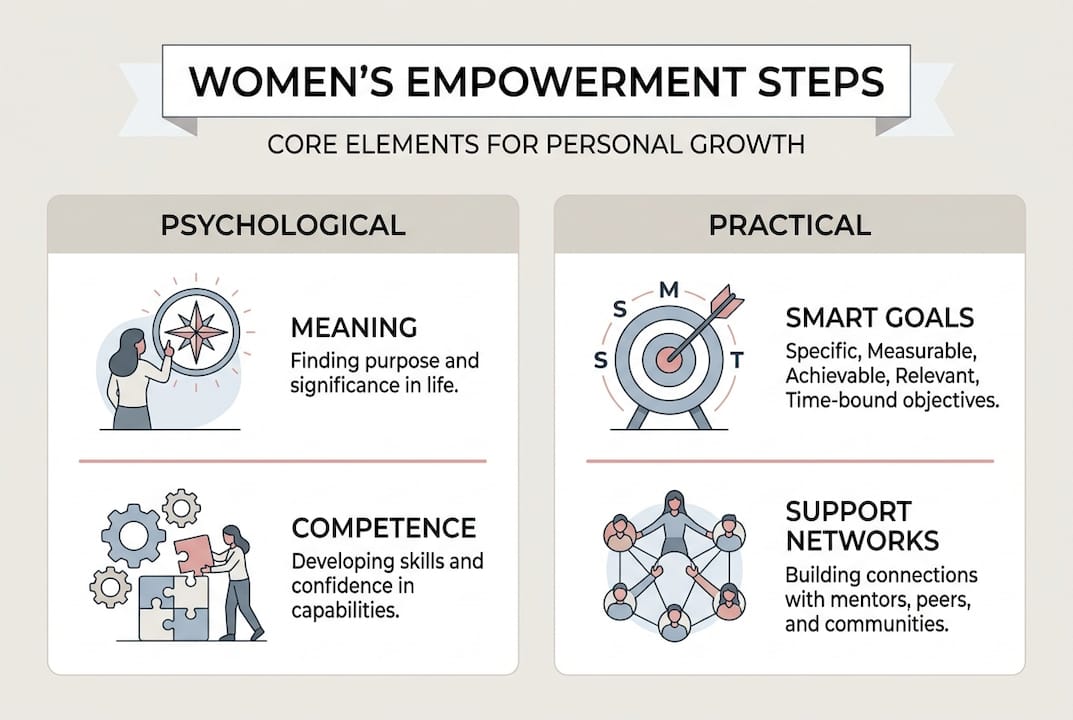
Psychological empowerment rests on four pillars: meaning, competence, self-determination, and impact. These core psychological components work together to create genuine confidence and motivation.
Meaning connects your actions to your values. When what you do aligns with what matters to you, motivation becomes intrinsic. You’re not chasing external validation but pursuing authentic goals.
Competence is your belief in your abilities. Self-efficacy research shows that when you trust your skills, you persist through challenges and set higher goals. This confidence isn’t arrogance but realistic self-assessment.

Self-determination gives you autonomy over your choices. Empowerment dies when every decision requires approval or when you’re constantly second-guessing yourself. True agency means owning your path.
Impact reflects your ability to influence outcomes. Feeling powerless drains motivation, while recognizing your effect on situations builds momentum. Small wins create the foundation for bigger changes.
Emotional regulation is essential to maintaining empowerment. The emotional steps for personal empowerment provide a practical framework:
These steps aren’t linear. You’ll cycle through them repeatedly as new challenges emerge. The key is building emotional literacy so you can navigate feelings without being controlled by them.
Boundary-setting deserves special attention. Many women struggle here because we’re socialized to prioritize others’ comfort over our own needs. Empowerment means recognizing that healthy boundaries benefit everyone by creating honest, sustainable relationships.
Pro Tip: Start with one small boundary this week. Notice how it feels to honor your limits, even if others initially resist. This practice builds the muscle for bigger boundary work.
Trusting your intuition connects to self-determination. Your gut often recognizes patterns before your conscious mind catches up. Women empowerment tips emphasize listening to that inner voice rather than dismissing it.
The connection between empowerment and mental health runs both ways. Feeling empowered improves emotional regulation, while good mental health provides the foundation for taking empowered action. The psychological empowerment research demonstrates measurable improvements in well-being when women develop these skills.
Seeking support isn’t weakness but wisdom. Empowerment doesn’t mean doing everything alone. It means knowing when to ask for help and building networks that sustain you through challenges.
Moving from theory to action requires concrete frameworks. The women empowerment workflow offers a structured approach to building sustainable change.
Start with honest self-assessment:
This foundation prevents you from chasing someone else’s version of empowerment. Your journey is uniquely yours.
Set SMART goals that foster clarity. Practical steps for empowerment include specific, measurable, achievable, relevant, and time-bound objectives. Vague intentions like “be more confident” become actionable when reframed as “speak up in three meetings this month.”
| Empowerment Area | Weak Goal | SMART Goal |
|---|---|---|
| Career | Get promoted | Complete leadership training and request quarterly reviews by June |
| Health | Exercise more | Attend yoga class twice weekly for 8 weeks |
| Relationships | Better boundaries | Practice saying no to one non-essential request each week |
| Financial | Save money | Automate $200 monthly transfer to savings account |
Build supportive networks intentionally. Empowerment flourishes in community, not isolation. Seek out women who challenge and inspire you. Join groups aligned with your goals, whether professional organizations or hobby-based communities.
Mentorship accelerates growth. Find someone two steps ahead on a path you’re exploring. Their experience helps you avoid common pitfalls and recognize opportunities. Be specific about what you need from mentors rather than expecting them to guess.
Engage in workshops and actionable activities regularly. Learning new skills builds competence, one of empowerment’s core elements. Choose activities that stretch you slightly beyond your comfort zone.
Pro Tip: Schedule empowerment activities like any other important appointment. Block time weekly for goal progress, whether that’s networking, skill-building, or reflection.
Track progress systematically. Use whatever method works for you: journal entries, spreadsheets, or apps. The act of monitoring creates accountability and reveals patterns. Celebrate milestones, even small ones. Recognition reinforces positive momentum.
The modern lifestyle empowerment guide emphasizes integration over addition. Rather than piling more onto your plate, weave empowerment practices into existing routines. Morning reflection during coffee, boundary practice during daily interactions, skill-building through podcasts during commutes.
Review and adjust quarterly. What worked last season might not fit current circumstances. Empowerment is dynamic, responding to life changes and new insights. Regular check-ins prevent you from rigidly pursuing outdated goals.
The empowerment action guide reminds us that consistency matters more than intensity. Small daily actions compound into significant change over months and years.
Empowerment isn’t a simple upward trajectory. Real-world complexities and contradictions shape women’s experiences in ways that deserve honest examination.
Economic empowerment illustrates these paradoxes. Earning income can increase autonomy but may paradoxically increase domestic violence risks in some cultures. Financial independence threatens traditional power structures, sometimes triggering backlash. This doesn’t mean women shouldn’t pursue economic empowerment, but it highlights the need for safety planning and support systems.
Popular feminism narratives vary wildly, affecting how women experience empowerment. Girlboss feminism commodifies empowerment by packaging it as hustle culture and consumer choices. Buy the right planner, adopt the morning routine, manifest success through positive thinking. This version often ignores systemic barriers while placing all responsibility on individual women.
Other narratives romanticize traditional submission or impose male career models as the only path to empowerment. Both extremes miss the nuance of authentic agency. True empowerment means choosing your path, whether that’s corporate leadership, homemaking, entrepreneurship, or something entirely different.
| Empowerment Narrative | Core Message | Potential Harm |
|---|---|---|
| Girlboss feminism | Hustle your way to success | Burnout, ignores systemic barriers |
| Tradwife romanticization | Find fulfillment through submission | Limits agency, financial vulnerability |
| Corporate feminism | Climb the ladder like men | One-size-fits-all, devalues other choices |
| Wellness empowerment | Self-care solves everything | Individualistic, ignores material needs |
Pressure to conform to any single empowerment model can harm emotional safety. When you’re constantly measuring yourself against Instagram-perfect versions of empowerment, authentic growth becomes impossible. The comparison trap steals energy from actual progress.
Cultural contexts matter enormously. Empowerment strategies effective in one setting may be dangerous or inappropriate in another. Understanding empowerment challenges requires acknowledging these differences rather than imposing universal solutions.
Key challenges women face:
The risks of women’s economic empowerment research shows that context-specific approaches work better than blanket prescriptions. Safety, support, and gradual change often prove more sustainable than dramatic overnight transformations.
Critiques of empowerment discourse include its potential to place all responsibility on individual women while ignoring systemic oppression. Personal empowerment matters, but it can’t single-handedly dismantle patriarchal structures. Both individual and collective action are necessary.
Respectful inclusion of men and broader social systems is essential for sustainable change. Empowerment isn’t about replacing one hierarchy with another but creating more equitable relationships and structures. When men feel threatened rather than invited into this transformation, resistance intensifies.
The feminism critiques remind us to stay critical of how empowerment gets packaged and sold. Question whose interests are served by particular empowerment narratives. Does this approach genuinely expand your agency, or does it primarily benefit someone selling you something?
Understanding these nuances supports more sustainable empowerment. You can pursue growth while acknowledging real constraints. You can celebrate progress while recognizing ongoing challenges. This balanced perspective prevents both naive optimism and paralyzing cynicism.
Ready to take your empowerment journey further? Womanedit offers curated resources designed specifically for women navigating personal growth, mental health, and lifestyle transformation.
Our women empowerment guide provides actionable strategies tailored to modern life’s unique challenges. You’ll find practical advice that respects your complexity rather than offering one-size-fits-all solutions.
Explore our confidence-boosting tips that go beyond surface-level affirmations. We focus on building genuine self-trust through small, sustainable actions that compound over time.
Discover how celebrity culture influences trends and what you can learn from public figures’ empowerment journeys. We examine both inspiration and cautionary tales to help you craft your authentic path.
Our expert content supports your mental health and empowerment simultaneously, recognizing that these dimensions can’t be separated. Join thousands of women building lives that reflect their values and aspirations.
Empowerment in daily life means making choices aligned with your values rather than external pressures. It shows up when you set a boundary at work, invest in your health, or speak up in relationships. These small moments of agency accumulate into lasting confidence and control over your circumstances.
Emotional regulation prevents feelings from hijacking your decisions. When you can recognize and manage emotions without being controlled by them, you maintain clarity during challenges. This skill allows you to respond thoughtfully rather than react impulsively, strengthening your sense of agency. Understanding why empowerment matters includes recognizing this emotional foundation.
Begin with honest self-assessment of your strengths and growth areas. Set one specific, measurable goal for the next month. Identify one boundary you need to establish and practice it this week. These concrete actions build momentum more effectively than vague intentions to “be more empowered.”
Cultural norms shape what empowerment looks like and what risks it carries. In some contexts, increased independence may trigger backlash from those invested in traditional power structures. Awareness of these dynamics helps you navigate empowerment safely while building necessary support systems. Context matters enormously in determining effective strategies.
Sustainable empowerment prioritizes emotional safety and realistic pacing over constant hustle. It’s about building capacity gradually rather than forcing dramatic overnight change. When you honor your limits while stretching toward growth, empowerment becomes a lifelong practice rather than a exhausting sprint.
Empowerment significantly enhances emotional regulation and mental well-being. Feeling competent and in control supports psychological resilience during challenges. Psychological empowerment training improved emotional regulation by 78% in research studies. The relationship is bidirectional: better mental health enables empowered action, while empowerment strengthens mental health.
Set SMART goals that translate vague intentions into concrete actions. Join mentorship programs to learn from others’ experiences and avoid common pitfalls. Participate in empowerment workshops that build specific skills aligned with your goals. Workshops, mentorship, and goal setting are proven effective activities. Consistency matters more than intensity in these practices.
Cultural norms determine which empowerment strategies are safe and effective in specific contexts. They shape family expectations, workplace dynamics, and community responses to women’s autonomy. In some cultures, increased financial autonomy may paradoxically increase domestic violence risk. Awareness of these factors helps you navigate empowerment while protecting your safety and building appropriate support systems.
Empowerment focuses on authentic agency and meaningful choices, not just working harder or achieving more. It prioritizes emotional well-being and sustainable growth over constant productivity. Sustainable empowerment prioritizes emotional safety over hustle, avoiding commodified narratives that package empowerment as endless self-optimization. True empowerment includes rest, boundaries, and honoring your humanity.