Newsletter Subscribe
Enter your email address below and subscribe to our newsletter

Enter your email address below and subscribe to our newsletter

Discover how female friendships shape mental health and empowerment. Learn to balance co-rumination risks with supportive bonds for stronger well-being.
Female friendships hold immense power to shape your mental health and sense of empowerment, but they also carry surprising risks. While deep connections with other women can buffer stress and build confidence, certain patterns like co-rumination increase anxiety and depression even as they strengthen bonds. This dual nature challenges the assumption that all close friendships are purely beneficial. Understanding how your conversations and support systems influence your well-being is key to harnessing the positive aspects while minimizing potential harm. This article explores how friendship behaviors affect mental health, offering insights to help you cultivate empowering, balanced relationships that truly support your growth.
| Point | Details |
|---|---|
| Friendship quality boosts mental health | Higher quality friendships promote comfort-seeking coping and reduce depression over time. |
| Co-rumination has dual effects | Extensive problem discussion strengthens bonds but raises anxiety and depression risk. |
| Empowerment talk protects well-being | Conversations focused on pride and empowerment reduce harmful coping like substance use. |
| Support buffers peer victimization | Trusted friendships decrease the impact of peer victimization on mental health. |
| Balance is essential | Managing co-rumination while fostering empowerment dialogue optimizes friendship benefits. |
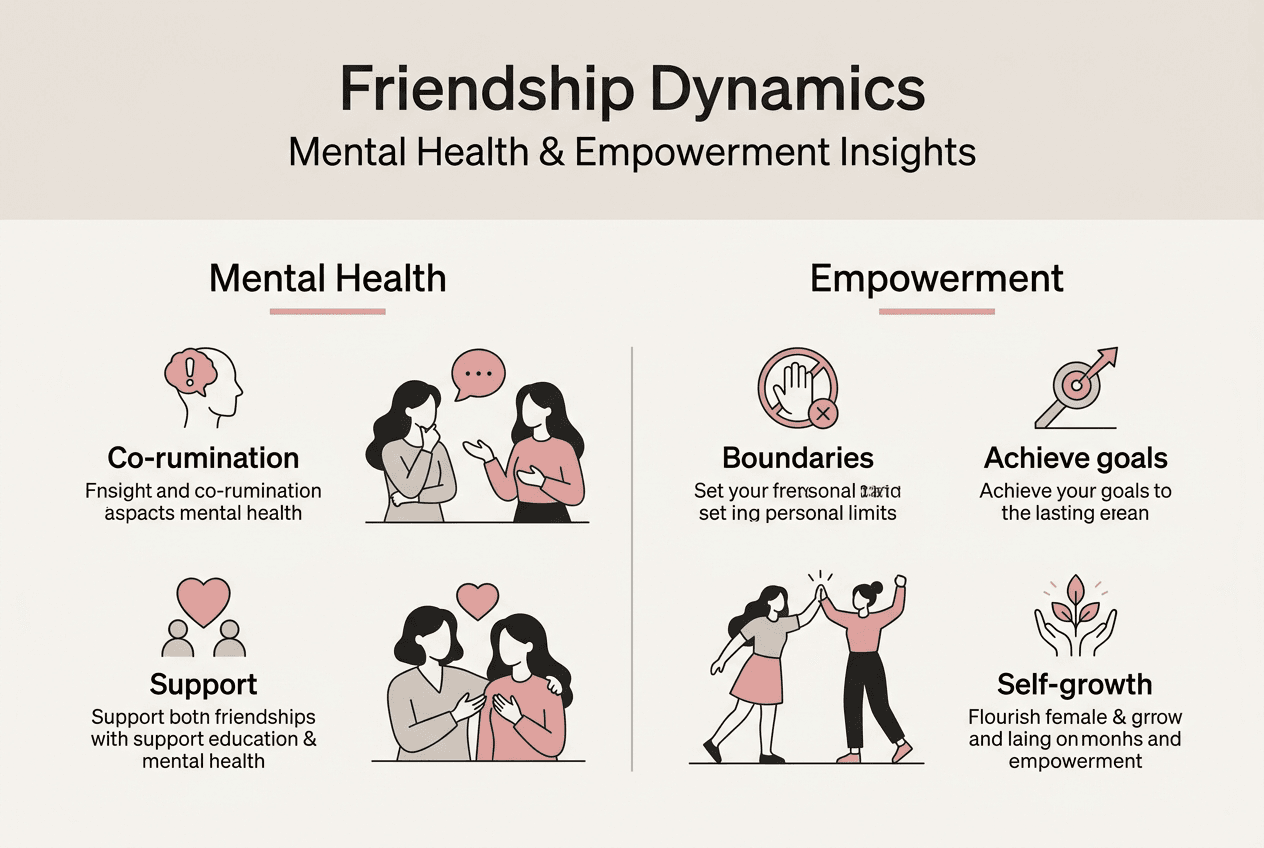
Female friendships operate through unique patterns that directly influence mental health outcomes. Co-rumination, defined as the extensive and repetitive discussion of problems within a friendship, creates a paradox. While it improves friendship closeness, it simultaneously heightens risk for depression and anxiety. You might feel closer to a friend after hours of analyzing a stressful situation, but that same conversation can amplify worry and negative emotions.
This dynamic becomes especially significant for young women of color navigating gendered racism. Research shows that close friendships mediate gendered racism’s impact on mental health, with co-rumination partially driving the link between racism exposure and anxiety. Trust and support within these friendships can buffer harm, yet excessive problem focus may deepen distress. The protective power emerges when conversations shift toward empowerment socialization, where friends discuss pride, resilience, and self-efficacy rather than dwelling solely on challenges.
Empowerment discussions offer a counterbalance to co-rumination’s risks. When you and your friends celebrate achievements, challenge limiting beliefs, and reinforce each other’s strengths, you reduce reliance on harmful coping mechanisms like substance use. These conversations build a foundation of confidence that helps you navigate stress without spiraling into anxiety. Online communities for women can complement in-person friendships by providing additional spaces for empowerment-focused dialogue.
Recognizing the difference between healthy sharing and risky co-rumination is crucial. Healthy sharing involves:
Risky co-rumination, by contrast, includes:
Pro Tip: Track how you feel after conversations with different friends. If you consistently feel more anxious or drained, gently steer future talks toward empowerment and solutions. This shift protects your mental health while maintaining closeness. Explore empowering relationship tips for women to build healthier communication patterns.
High-quality friendships serve as powerful protective factors for mental health by promoting comfort-seeking coping, a strategy where you actively seek emotional support during stressful times. Unlike avoidance or denial, comfort-seeking involves reaching out to trusted friends who validate your feelings and help you process challenges constructively. This approach reduces peer victimization and depression over time, creating a buffer against the negative effects of social stress.
Supportive friendships offer protection through several key mechanisms. When you experience peer victimization, whether through exclusion, gossip, or criticism, a trusted friend can reframe the experience and remind you of your worth. This external validation counters the internalized shame and self-doubt that often accompany victimization. Quality friendships also provide a safe space to express vulnerability without judgment, which is essential for emotional regulation and resilience.
Five ways high-quality friendships promote mental health:
Experts emphasize the foundational role of trust in these protective effects. As one researcher noted:
Trust and support in female friendships create a psychological safety net that allows women to take risks, express authentic emotions, and develop resilience against external stressors.
This safety net becomes especially important during transitions like career changes, relationship challenges, or health concerns. Friends who consistently show up, listen without judgment, and offer genuine care help you maintain stability even when life feels chaotic. Over time, these supportive interactions build a reservoir of positive experiences that protect against depression and anxiety.

The protective benefits extend beyond immediate crisis support. Quality friendships foster long-term mental health by creating patterns of healthy interdependence. You learn to ask for help when needed, offer support without depleting yourself, and maintain boundaries that preserve both the friendship and your individual well-being. This balance is central to why women empowerment matters, as it builds the social foundation for personal growth and confidence.
Pro Tip: Nurture trust by practicing active listening and following through on commitments. Small, consistent actions like checking in after a tough day or remembering important events build the reliability that makes friendships truly protective. Discover ways to support women in your life to strengthen these bonds. For comprehensive strategies, review this women empowerment guide.
The relationship between co-rumination and friendship quality presents a nuanced trade-off that requires careful navigation. While extensive problem discussion strengthens emotional bonds, it also increases vulnerability to internalizing problems like depression and anxiety, particularly among women. Understanding this balance helps you maximize closeness while minimizing mental health risks.
| Aspect | Benefits | Risks |
|---|---|---|
| Emotional bonding | Deepens intimacy and trust through shared vulnerability | Can create dependency on problem-focused connection |
| Mental health impact | Validates feelings and reduces isolation | Increases anxiety and depression through rumination |
| Coping patterns | Encourages seeking support during stress | May reinforce avoidance of solution-focused action |
| Friendship stability | Builds perceived closeness and mutual understanding | Can lead to burnout if negativity dominates interactions |
Research using Structural Equation Modeling reveals that co-rumination partially mediates the racism exposure-anxiety link, with trust and support creating a chain mediation effect on well-being. This means that while co-rumination can amplify anxiety stemming from discriminatory experiences, the trust built through these conversations can simultaneously provide protective benefits. The key lies in whether the friendship also incorporates empowerment discussions that shift focus from problems to strengths.
Empowerment discussions offer critical protective effects against harmful coping strategies. When you and your friends talk about personal achievements, challenge societal limitations, and reinforce each other’s capabilities, you reduce reliance on substance use and other risky behaviors. These conversations build pride and self-efficacy, creating a positive counterweight to the anxiety that co-rumination can generate. The contrast is clear: co-rumination trades off friendship quality versus internalizing risks, making it essential to balance both communication styles.
Signs that co-rumination is helpful:
Signs that co-rumination is harmful:
Edge cases complicate this picture. High levels of social support can mitigate some risks of co-rumination, but when problem-focused talk becomes the primary mode of connection, even strong support may not prevent increased anxiety. Similarly, friends who engage in moderate co-rumination while also celebrating successes and discussing empowerment tend to experience fewer negative effects than those who ruminate extensively without positive balance.
Pro Tip: Set intentional boundaries around problem-focused conversations. Try limiting deep problem discussion to 20 minutes, then consciously shift to empowerment topics or solution brainstorming. This structure maintains closeness while protecting your mental health. Explore the women empowerment workflow for additional strategies. Learn more about what is women empowerment to deepen your understanding of these protective conversations.
Transforming friendship knowledge into actionable strategies empowers you to build relationships that genuinely support your mental health and personal growth. The goal is cultivating high-quality connections that balance emotional intimacy with healthy boundaries, creating space for both vulnerability and empowerment.
Practical steps to nurture balanced, high-quality friendships:
Five daily habits to promote supportive, mindful conversations:
Recognizing harmful co-rumination requires honest self-assessment. If you notice that conversations with a particular friend consistently leave you feeling worse, it’s time to shift the dynamic. Start by gently redirecting when problem talk begins to loop. You might say, “I hear how tough this is. What would feel empowering right now?” or “Let’s brainstorm one concrete thing you could try this week.” This approach maintains support while steering away from rumination.
Seeking comfort-seeking coping without deepening anxiety involves choosing the right moment and framing. When you need support, be specific about what would help. Instead of open-ended venting, try, “I’m struggling with this situation and would love to talk it through, then maybe we could focus on something positive together.” This sets expectations that support doesn’t mean endless problem focus.
Cultivating diverse social circles, including online communities for women, expands your support network and prevents over-dependence on a single friendship. Different friends can meet different needs: one might excel at empowerment conversations, another at practical problem-solving, and another at providing distraction and fun. This diversity protects your mental health by ensuring you’re not placing all emotional weight on one relationship.
Your friendships are powerful tools for well-being and self-growth when you approach them with intention and awareness. By balancing emotional depth with empowerment, setting healthy boundaries, and diversifying your connections, you create a social foundation that truly supports your mental health and confidence. Discover empowerment tips to boost confidence and explore empowering relationship tips to continue building these skills.
Navigating the complexities of female friendships and mental health becomes easier with expert guidance tailored to your needs. WomanEdit offers comprehensive resources on empowerment, wellness, and relationships designed specifically for modern women seeking to enhance their social connections and personal well-being.
Our platform features in-depth guides on building confidence, managing relationships, and cultivating mental health through intentional social practices. Whether you’re looking to strengthen existing friendships, develop healthier communication patterns, or explore new ways to support other women, WomanEdit provides actionable insights grounded in research and real-world experience. Discover our women empowerment guide for comprehensive strategies, explore empowering relationship tips for women to transform your connections, or visit the WomanEdit homepage to access our full range of lifestyle, mental health, and empowerment content.
Co-rumination involves repetitive, excessive focus on problems without moving toward solutions, which increases anxiety and depression risk over time. Healthy sharing balances emotional support with solution-focused thinking, positive topics, and time boundaries. The key difference lies in whether conversations leave you feeling supported and empowered or stuck and more anxious.
Yes, empowerment discussions reduce substance use coping and other harmful behaviors by building pride and self-efficacy. When friends focus on strengths, achievements, and resilience rather than only problems, they create protective mental health benefits. These conversations counterbalance the anxiety that can arise from excessive co-rumination.
Set clear time limits on problem-focused conversations, such as 20 minutes before shifting to solutions or positive topics. Encourage empowerment dialogue by celebrating wins and discussing personal growth. When problems feel overwhelming, seek external professional support like therapy rather than relying solely on friends. These boundaries maintain closeness while protecting mental health.
Socialization patterns encourage girls and women to prioritize emotional sharing and relational intimacy from a young age. This communication style promotes deep closeness but also creates vulnerability to internalizing risks like anxiety and depression. The trade-off between friendship quality and mental health risks is more pronounced in female friendships due to these gendered expectations around emotional expression.