Newsletter Subscribe
Enter your email address below and subscribe to our newsletter

Enter your email address below and subscribe to our newsletter

Work-life balance is vital for young professional women. Learn its impact on mental health, productivity, risks of imbalance, and actionable empowerment strategies.
Long meetings run late, family texts ping between deadlines, and your to-do list never seems to end. The struggle to create functional harmony between work and personal life is not just a buzzword—it is the daily reality for women balancing multiple roles. As modern workplaces across the United States, Canada, and worldwide shift toward more flexibility, the challenge now is crafting a sustainable equilibrium that truly fits your life. Discover how redefining balance on your own terms can support both your career goals and mental well-being.
| Point | Details |
|---|---|
| Personalized Work-Life Balance | Work-life balance is subjective and varies by individual needs and circumstances. It is essential to define what balance means for you without external comparisons. |
| Flexibility is Crucial | Prioritize flexibility in your work schedule to accommodate personal responsibilities. This flexibility allows women to manage their dual roles more effectively. |
| Set Strong Boundaries | Establish clear boundaries between work and personal life to protect your time and reduce stress. This includes turning off work notifications after hours and being selective with commitments. |
| Invest in Self-Care | Regularly prioritize self-care activities that recharge you, as this is fundamental for maintaining mental health and productivity. Treat self-care like a non-negotiable appointment. |
Work-life balance isn’t about dividing your hours equally between work and personal life. It’s about creating functional harmony between your professional responsibilities and the other parts of your life that matter most to you.
The concept gained traction in 1986, but it’s evolved significantly since then. Today’s definition recognizes that women juggle multiple roles simultaneously—not just as employees, but as parents, caregivers, partners, and individuals with personal aspirations. [Work-life balance for women] (https://www.deloitte.com/us/en/insights/topics/talent/work-life-balance-for-women.html) goes beyond simply “having time off.” It’s about achieving a sustainable equilibrium where you’re not constantly sacrificing one area of life for another.
Women face unique pressures that men often don’t encounter at the same intensity. Your work-life balance challenge isn’t just about managing hours; it’s about managing expectations and societal roles that overlap in complicated ways.
Consider these realities most women face:
Work-life balance for women isn’t about perfect equality between domains—it’s about having enough control over when, where, and how you work to meet your personal needs without constant guilt or burnout.
The shift happening now isn’t about where you work anymore. Remote work exists. The real question is when you work and whether you have flexibility in that timing. A woman managing a sick child needs different flexibility than a colleague without caregiving responsibilities.
Here’s what often gets missed: your work-life balance looks different from your coworker’s. What feels balanced to you might feel overwhelming to someone else—and vice versa.
Some women thrive with ambitious careers and structured family time. Others prioritize flexibility and autonomy over climbing the corporate ladder. Neither is “wrong.” Neither requires guilt.
Your version of balance accounts for:
The [evolving concept of work-life balance] (https://link.springer.com/article/10.1186/s43093-025-00584-w) emphasizes that you’re not aiming for strict equality. You’re aiming for a working equilibrium that lets you show up meaningfully in the areas that matter most to you right now.
That might mean intense work seasons followed by personal recovery time. It might mean working part-time while building a side project. It might mean a full-time career with strong boundaries around your evenings and weekends. All of these are valid balance.
Pro tip: Stop comparing your balance to anyone else’s and spend one week tracking how you actually spend your time versus how you want to spend it. Write down three specific changes that would make your life feel more balanced, then pick one small action to start this week.
Work-life balance isn’t a one-size-fits-all problem, and the challenges you face depend heavily on your specific situation. A single woman in tech faces different obstacles than a mother of three working in healthcare, yet both struggle with balance in ways unique to their circumstances.
The reality is that [gender differences in work-life balance] (https://www.sciencedirect.com/science/article/pii/S0001691825003324) are significant and often overlooked. Women consistently report higher levels of conflict between work and personal life, even when working the same hours as men.
One of the biggest challenges women face is the unequal caregiving responsibility, whether that’s children, aging parents, or both. Even when both partners work full-time, women typically shoulder more of the mental and physical caregiving load.
This burden shows up as:
The caregiving gap isn’t just about time—it’s about mental load. You’re thinking about everything that needs doing, even when you’re at work.
Many organizations still haven’t caught up with what women actually need. Flexible work arrangements exist on paper but not in practice. Asking for flexibility can signal you’re “not committed,” which affects promotions and raises.
Common workplace challenges include:
The [multifaceted challenges of balancing work and personal life] (https://ijsret.com/wp-content/uploads/2025/03/IJSRET_V11_issue2_610.pdf) directly affect your physical and mental health. Women report higher rates of stress, anxiety, and burnout when work-life balance feels impossible.
You might experience:
Women who prioritize flexibility or take time for caregiving often face wage penalties and slower advancement. You might earn less not because you work less hard, but because you work differently or take breaks that men don’t face the same pressure to take.

This creates a painful trap: you need flexibility to manage your life, but seeking it limits your earning potential and career growth. That’s not a personal failing—that’s a systemic problem.
Here’s a quick comparison of common work-life balance obstacles and their impacts on women:
| Obstacle Type | Unique Challenge for Women | Long-Term Risk |
|---|---|---|
| Caregiving Burden | Balancing multiple caregiving roles | Chronic exhaustion, stress |
| Workplace Policy Gap | Limited flexible scheduling options | Slowed career advancement |
| Mental Load | Managing both work and home details | Anxiety, decreased wellness |
| Wage Gap | Earnings impacted by flexibility needs | Reduced financial security |
Pro tip: Document the actual impact of your workload and identify which specific tasks or meetings drain your energy most. Propose one concrete change to your manager—like “checking email only twice daily” or “moving Wednesday meetings to Tuesday and Thursday”—with clear benefits for both you and the organization.
When you achieve work-life balance, the benefits ripple across every area of your life. This isn’t about being more productive at work or having more free time—though both happen. It’s about becoming a healthier, happier version of yourself in every role you play.
The most immediate benefit most women notice is improved mental health. When you’re not constantly stressed about failing at work or failing at home, anxiety and depression often ease significantly.
A balanced life supports your mental wellness through:
[Work-life balance directly improves women’s mental health] (https://link.springer.com/article/10.1186/s43093-025-00584-w), reducing stress, anxiety, and burnout while enhancing overall well-being and life satisfaction.
Counters to popular belief, achieving balance actually strengthens your career. Women with better work-life balance report higher job satisfaction and perform better at work, not worse.
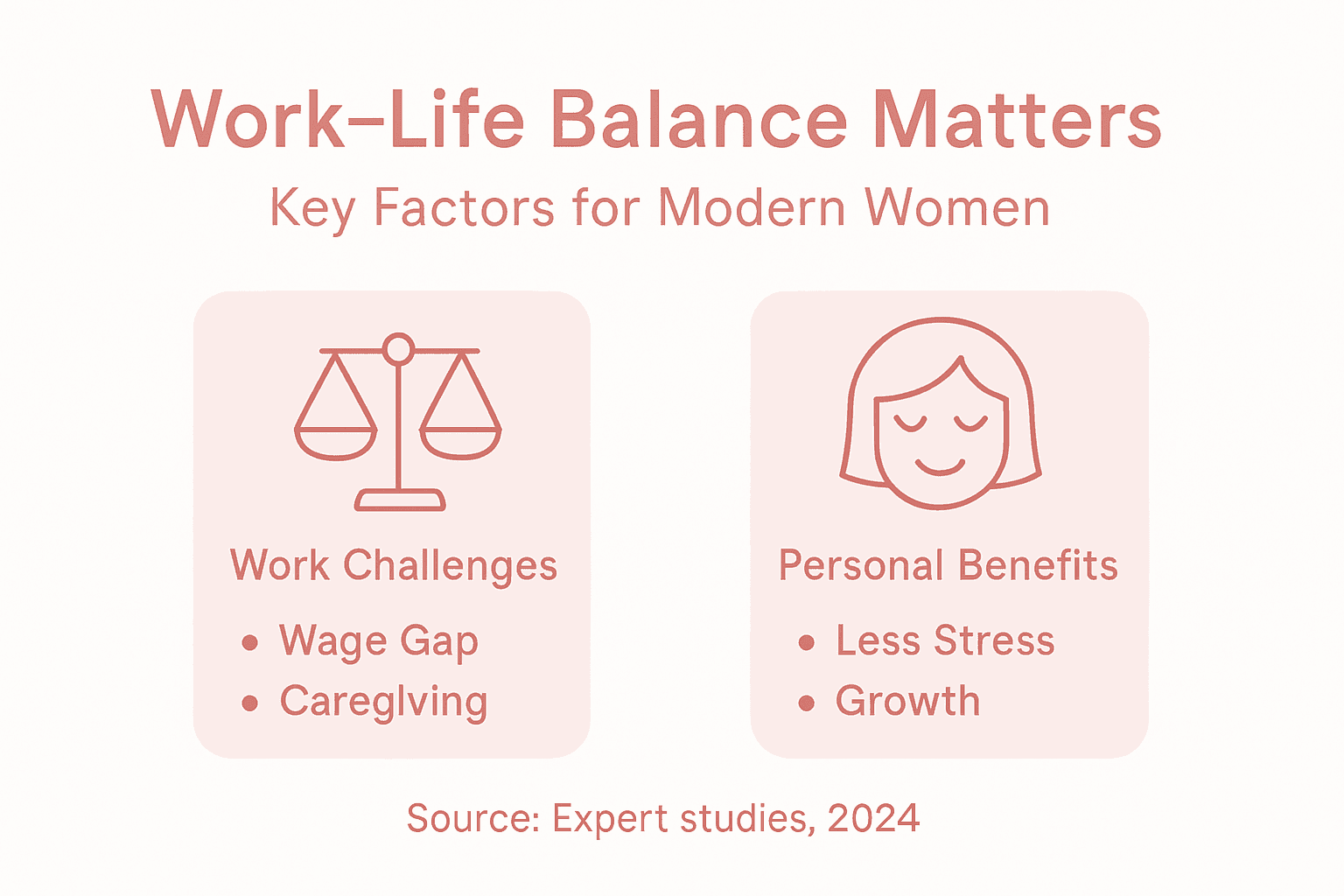
Why? Because rest fuels performance. When you’re not exhausted, you bring your best thinking to work. You’re more creative, more focused, and more resilient when facing challenges.
Professional benefits include:
Balance creates space for you—not as a worker or caregiver, but as a person. [Work-life balance enables personal growth and self-independence] (https://scientificresearchjournal.com/wp-content/uploads/2024/12/social-science-vol-11-614-619.pdf), allowing women to invest in their own development and interests.
This might look like finally reading that book, training for a marathon, learning a new skill, or reconnecting with friends. These aren’t luxuries—they’re foundational to your sense of self and long-term well-being.
Personal benefits include:
When you actively manage your work-life balance, you’re not just reducing stress. You’re reclaiming agency over your own life. You’re choosing your priorities instead of letting external demands decide for you.
This shift from reactive to proactive is transformative. You move from “I have to do everything” to “I choose what matters most and protect time for it.” That’s genuine empowerment.
Pro tip: Identify one area of your life where you feel most fulfilled (relationships, health, creativity, career). This week, add just 30 minutes to this area intentionally. Notice how small investments in what matters most shift your overall sense of balance and purpose.
When work-life balance tips into imbalance, the consequences aren’t just inconvenient—they’re serious. Chronic stress and burnout don’t develop overnight, but they accumulate quietly until you hit a breaking point.
The stakes are real. [Work-life imbalance leads to chronic stress] (https://sfihealth.com/news/the-work-life-balance-and-womens-mental-health) and emotional exhaustion, with women facing particular vulnerability due to their dual roles at work and home. This isn’t dramatic—it’s the everyday reality for millions of women globally.
Women experience what researchers call the “double burden”—juggling professional responsibilities alongside caregiving, household management, and emotional labor. Unlike men who often have one primary role, you’re expected to excel in multiple demanding roles simultaneously.
This creates a unique pressure because:
[Working women experience significantly higher stress and burnout] (https://ijip.in/wp-content/uploads/2025/02/18.01.264.20241201.pdf) despite often having better psychological well-being in other areas, revealing the unique toll of balancing professional and domestic responsibilities.
Chronic imbalance manifests physically. Your body keeps score through headaches, muscle tension, digestive issues, weakened immunity, and sleep disruption. These aren’t complaints—they’re signals that your system is overwhelmed.
Prolonged stress impacts your body through:
Burnout isn’t just feeling tired. It’s a state of emotional exhaustion where you feel depleted, cynical, and detached from work and life. You stop caring about things that once mattered because you’re running on empty.
Warning signs include:
When you’re burned out, your relationships suffer. You have less patience, less energy for connection, and less presence with people you love. Partners feel neglected, kids sense your stress, friendships fade from neglect.
This creates additional guilt and isolation, intensifying the burnout cycle.
Burnout recovery takes significantly longer than prevention. Once you’re severely burned out, returning to baseline health can take months or years. That’s why addressing imbalance early—before it becomes burnout—is genuinely protective.
Pro tip: Track one warning sign this week: sleep quality, irritability level, or number of times you feel overwhelmed. If it’s trending negatively, make one small change immediately—like setting an email cutoff time or declining one optional commitment. Early intervention prevents crisis.
Achieving work-life balance isn’t about finding more hours in the day. It’s about making intentional choices about where your energy goes and protecting what matters most.
The good news? There are proven strategies that actually work. These aren’t theoretical ideals—they’re actionable steps you can implement starting today.
Boundaries are non-negotiable for protecting your personal time. Without them, work expands infinitely and personal life gets whatever’s left over—which is usually nothing.
Effective boundaries look like:
[Prioritizing health and setting boundaries] (https://www.psychologytoday.com/us/blog/physio-and-psych/202410/practical-strategies-to-build-and-maintain-lifework-balance) are essential practices for maintaining work-life balance and sustaining long-term well-being.
Boundaries feel selfish at first. They’re not. They’re the foundation of sustainable performance and presence.
Self-care isn’t bubble baths and spa days—though those can be part of it. It’s actively protecting activities that restore you, whether that’s exercise, sleep, creative pursuits, or time with people you love.
Treat self-care like a non-negotiable appointment:
[Flexible work hours and caregiving support] (https://www.innovativehumancapital.com/article/empowering-women-through-work-life-balance-policies-and-practices) empower women by providing the flexibility needed to manage professional and personal responsibilities effectively.
If your organization doesn’t offer flexibility, make a case for it. Document how flexible arrangements increase your productivity. Propose specific options: compressed workweeks, remote work days, or flexible start times.
You might also build a [women empowerment workflow for change] (https://womanedit.com/women-empowerment-workflow-action-guide) by collaborating with colleagues to request organizational support for work-life balance initiatives.
You’re taught that productivity equals hours worked. That’s false. Rest, boundaries, and personal fulfillment actually increase your professional effectiveness.
Rethink productivity by:
You cannot maintain balance alone. Identify the people, resources, and services that support your well-being—whether that’s a therapist, trusted friends, family help, or professional services like meal prep or cleaning.
Investing in support isn’t luxury. It’s strategic.
Below is a summary of strategies that empower women to achieve better work-life balance:
| Empowering Strategy | Key Action | Expected Benefit |
|---|---|---|
| Setting Clear Boundaries | Defining work limits | More personal recharge time |
| Investing in Self-Care | Scheduling restorative acts | Improved resilience |
| Advocating for Flexibility | Requesting custom schedules | Career and life alignment |
| Building Support Systems | Engaging help or resources | Reduced overwhelm |
Pro tip: This week, identify your biggest time drain that doesn’t align with your priorities. Can you delegate it, eliminate it, or batch it into one designated time? Make one change immediately and track how it affects your stress level and available energy.
Struggling with the unique challenges of balancing career, caregiving, and personal well-being is a reality for many modern women. This article highlights how critical it is to find a sustainable equilibrium where you control when and how you work without burnout or guilt. At WomanEdit, we understand that achieving work-life balance means embracing your personal definition of success while managing mental load and societal pressures.
Discover stories that inspire and empower your lifestyle choices with exclusive insights on mental health, career, and personal growth. Visit WomanEdit now for engaging content that supports your journey toward empowerment and balance. Take the first step today by exploring tips on mental wellness and women empowerment to create meaningful change in your life.
Work-life balance for women involves creating functional harmony between professional responsibilities and personal life, understanding that it’s not just about equal time allocation but about meeting personal needs without guilt or burnout.
Women often face unique pressures, such as juggling career ambitions with caregiving responsibilities and managing societal expectations, making balance crucial for their mental health and overall well-being.
Women can achieve better work-life balance by setting clear boundaries, investing in self-care, advocating for flexible work arrangements, and building support systems to manage demands from both work and home effectively.
Poor work-life balance can lead to chronic stress, burnout, physical health issues, and deterioration of personal relationships, highlighting the need for proactive measures to maintain a healthy equilibrium.
Source: Editorial Use | Image: Editorial Use