Newsletter Subscribe
Enter your email address below and subscribe to our newsletter

Enter your email address below and subscribe to our newsletter

Why follow trending colors? Discover how embracing color trends boosts style, mood, and personal branding, plus tips for empowering wardrobe updates.
Every season, the excitement of discovering new colors on the runways sparks fresh inspiration across the fashion world. Whether you love vibrant pinks or prefer soft neutrals, trending hues do more than update your look—they help express your personality, boost confidence, and reflect current moods. Influenced by sources like New York Fashion Week and the Pantone Color Institute, these evolving palettes become powerful tools for personal storytelling and self-care. Embracing trendy colors lets you align your style with both contemporary culture and your own emotional well-being.
| Point | Details |
|---|---|
| Trending Colors Reflect Cultural Expressions | Trending colors serve as powerful storytelling tools that communicate deeper social conversations about identity and personal expression. |
| Personal Style Is Enhanced by Color Psychology | The strategic selection of colors can align personal style with emotions, identity, and cultural connections, bolstering self-perception. |
| Balance Is Key in Trend Participation | Engaging with trends requires a thoughtful balance to avoid identity erosion and cognitive stagnation while still participating meaningfully. |
| Actionable Color Integration Strategies | Confidently adapt trending colors by considering context, personal tone, and gradual integration to maintain authenticity in style choices. |
Fashion color trends are dynamic visual languages that communicate cultural moods, individual expressions, and design philosophies. These colors emerge from complex networks of influences – from runway shows to street style, global events to artistic movements. Pantone Color Institute experts meticulously analyze global fashion weeks to forecast seasonal color palettes that capture contemporary zeitgeist.
Trending colors represent more than aesthetic choices – they’re powerful storytelling tools. For Spring/Summer 2026, fashion forecasters anticipate a compelling color narrative that balances emotional depth with visual vibrancy. These anticipated palettes typically include:
Understanding trending colors requires recognizing they’re not just about what looks good, but what feels meaningful. Modern color trends reflect broader social conversations about identity, authenticity, and personal expression. A vibrant pink or muted sage isn’t just a color – it’s a statement about how we see ourselves and want to be perceived.
Designers and fashion enthusiasts track these color movements through multiple channels, including:
Trending colors are visual poetry – they tell stories without words, communicating complex emotions through subtle chromatic choices.
Pro tip: Follow color trend reports from respected institutions like Pantone to stay ahead of fashion’s visual language and make informed styling choices.
Personal style is a nuanced form of self-expression where color plays a pivotal psychological role. Psychological research reveals that our color choices are deeply connected to personality traits, allowing individuals to communicate complex emotional narratives through fashion.
Trending colors offer a unique palette for personal storytelling, enabling individuals to align their wardrobe with contemporary cultural expressions. These colors function as more than aesthetic choices – they’re powerful communication tools that reflect inner identity. The strategic selection of trending colors can help people express themselves in several key ways:
The psychological impact of color selection goes beyond simple visual appeal. Fashion color psychology demonstrates that specific hues can dramatically influence mood, confidence, and interpersonal interactions. A vibrant emerald green might signal creativity and ambition, while a soft lavender could communicate introspection and sensitivity.
Modern fashion enthusiasts understand that trending colors are not about blind conformity, but about thoughtful personal interpretation. By understanding color psychology, individuals can:
Color is the silent language of personal style – speaking volumes without uttering a word.
Pro tip: Experiment with trending colors by introducing them as subtle accents before fully committing to a complete color-based style transformation.
Color trends emerge from complex interconnected systems that analyze sociological, psychological, and cultural dynamics. These trends are not random, but carefully curated collective preferences that reflect deeper human experiences and societal shifts.
Multiple sources contribute to color trend development, creating a sophisticated ecosystem of trend generation:
Trend forecasting organizations like the Pantone Color Institute play a crucial role in analyzing and predicting these trends. They leverage massive cross-industry datasets, examining millions of commercial applications across fashion, technology, art, and consumer products to identify emerging color narratives.
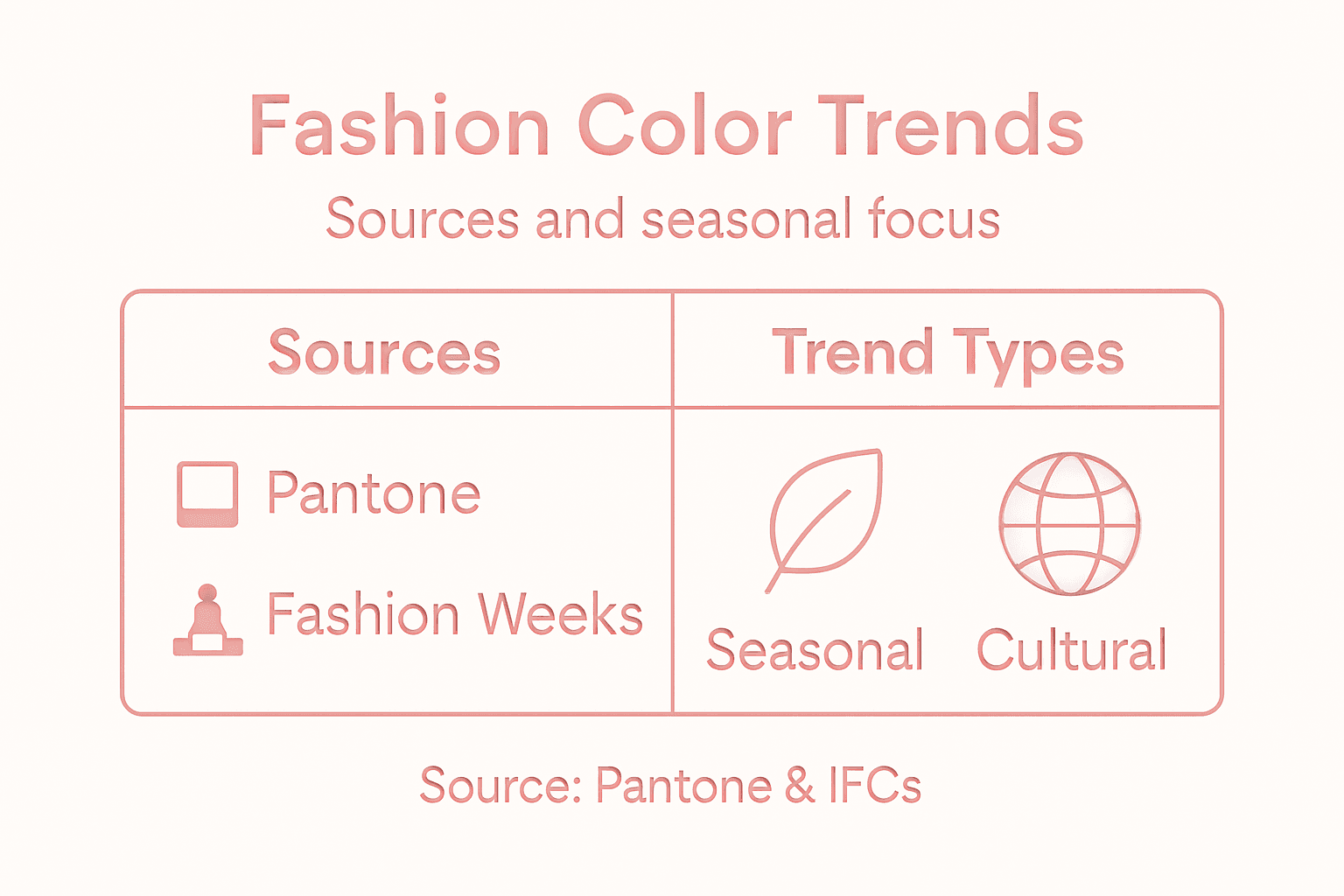
Color trends typically manifest in several distinct categories:
Here’s how key types of color trends differ in fashion:
| Trend Type | Defining Feature | Main Influence Source | Example Application |
|---|---|---|---|
| Seasonal Trends | Changes with fashion seasons | Runway shows, designer lines | Spring/Summer color palettes |
| Cultural Trends | Reflects societal movements | Art, social events | Colors in protest movements |
| Industrial Trends | Driven by tech/manufacturing shifts | Innovation, new materials | Tech-inspired fashion hues |
| Global Aesthetic Trends | Global collective preferences | Social media, global events | International street style |
Color trends are living narratives – visual languages that communicate collective human experiences.
Pro tip: Follow reputable trend forecasting platforms and observe global design conferences to stay ahead of emerging color movements.
Trend participation satisfies fundamental psychological needs for social connection and personal validation. The human brain is wired to seek belonging, and engaging with current trends provides a powerful mechanism for reducing social isolation and enhancing personal identity.
The psychological mechanisms behind trend following are complex and multifaceted:
Evolutionary psychology reveals that our brains are fundamentally designed to prioritize group survival. Trends serve as modern social signals, allowing individuals to demonstrate adaptability, cultural awareness, and emotional intelligence through seemingly simple aesthetic choices.
The neurological rewards of trend participation extend beyond surface-level interactions. When individuals align with current trends, they experience:
Trends are more than fashion – they’re a language of belonging, communication without words.
Pro tip: Approach trend participation as a form of personal exploration, not blind conformity – choose trends that genuinely resonate with your authentic self.
Trend participation requires strategic balance between engagement and individual authenticity. Navigating trend landscapes involves understanding potential psychological and social risks associated with both excessive adoption and complete rejection of current cultural movements.
The primary risks of trend interactions include:
Academic research highlights the dangers of over-reliance on trending technologies and methodologies. Excessive trend absorption can lead to:
Modern trend participation demands nuanced approaches that preserve personal authenticity while maintaining social relevance. Intelligent trend engagement requires constant self-reflection, ensuring that external influences complement rather than replace individual identity.
Compare the psychological benefits and potential risks of following fashion color trends:
| Aspect | Benefits of Following Trends | Risks of Overdependence |
|---|---|---|
| Social Connection | Stronger sense of belonging | Fear of social exclusion |
| Personal Identity | Opportunity for self-expression | Loss of individual perspective |
| Mental Well-being | Boosts confidence and mood | Increased validation anxiety |
| Creativity | Inspires new style ideas | Suppression of personal vision |
Trends are tools for expression, not dictates to be blindly followed.
Pro tip: Develop a personal trend filter by critically evaluating each trend’s alignment with your authentic self before adoption.
Color theory principles unlock confident styling by providing strategic frameworks for integrating trendy hues into personal wardrobes. Understanding how colors interact allows fashion enthusiasts to experiment with trending palettes while maintaining individual authenticity.
Confident color adaptation involves multiple strategic approaches:
Psychological color research demonstrates that strategic color choices can significantly impact mood and perception. Selecting trending colors requires thoughtful evaluation of:
Successful trend adaptation is less about perfect replication and more about personalized interpretation. The most confident style transformations occur when individuals view trending colors as inspiration, not mandatory dictates.
True style confidence emerges from authentic self-expression, not blind trend following.
Pro tip: Start with small color accent pieces to test trending hues before making substantial wardrobe investments.
Navigating the ever-changing world of fashion color trends can feel overwhelming, especially when you want to express your authentic self while staying connected to the latest styles. This article highlights the challenge of balancing emotional resonance, personal identity, and social relevance through strategic color choices. If you have ever wondered how to confidently integrate energetic statement colors or minimalist neutrals into your wardrobe without losing your unique voice, you are not alone. The key is thoughtful adaptation supported by understanding color psychology and trend insights.
Explore style inspiration and self-expression tips at WomanEdit to stay informed and empowered.
Discover exclusive content that helps you decode the language of trending colors and build outfits that boost your confidence and creativity. Whether you are seeking guidance on emotional resonance, identity signaling, or simply want fresh ideas to amplify your personal style, WomanEdit offers curated articles and trend reports designed with modern women like you in mind. Don’t wait to transform your fashion impact today by joining a community passionate about women’s empowerment and style innovation. Start your trend journey now at WomanEdit.
Trending colors are crucial as they provide a visual language that reflects cultural moods and individual expressions. They help set the tone for personal style and allow individuals to connect with contemporary cultural narratives.
You can start by analyzing your personal palette and gradually introducing trending colors as accents. Pay attention to the emotional resonance of the colors with your mood, and consider the context of different occasions when selecting outfits.
Following fashion trends can strengthen social connections, enhance personal identity, and boost mental well-being. Engaging with trends can increase confidence, inspire creativity, and help individuals feel more connected to current cultural dialogues.
Ignoring trends might lead to social misalignment or a perception of being outdated, while overusing trends can result in diminished personal expression and creativity. It’s essential to find a balance and ensure that following trends complements one’s individual style rather than overshadows it.
Source: Editorial Use | Image: Editorial Use