Newsletter Subscribe
Enter your email address below and subscribe to our newsletter

Enter your email address below and subscribe to our newsletter


Discover a step-by-step self-care guide for women designed for mental well-being. Learn actionable routines for relaxation, confidence, and a balanced lifestyle.
Constant scrolling through social media can leave you feeling drained and disconnected. For women balancing life’s demands and absorbing nonstop celebrity news, tending to mental well-being has never felt more important. By exploring a comprehensive self-care assessment and building routines that truly fit your lifestyle, you can uncover simple steps to boost energy, emotional health, and personal satisfaction—without adding more stress to your day.
| Key Point | Explanation |
|---|---|
| 1. Assess Your Self-Care Needs | Honestly evaluate your current wellness habits to identify areas for improvement. This step sets the foundation for your self-care strategy. |
| 2. Create a Personalized Routine | Develop a self-care routine tailored to your unique goals and energy levels, ensuring it feels supportive rather than overwhelming. |
| 3. Incorporate Mindfulness | Practice mindfulness techniques regularly to enhance emotional healing and reduce stress, helping you become more present in your daily life. |
| 4. Build Supportive Connections | Cultivate meaningful social connections that inspire and energize you, focusing on the quality of relationships over quantity. |
| 5. Track Progress and Adjust | Regularly monitor your self-care journey to identify effective strategies and make necessary adjustments, as progress is not always linear. |
Undertaking a comprehensive self-care assessment means taking an honest look at your current wellness habits and identifying potential areas for improvement. This crucial step helps you create a personalized strategy that supports your mental and physical health.
To begin your self-care evaluation, consider exploring a structured assessment worksheet that guides you through rating different aspects of your well-being. These assessments typically cover multiple dimensions of health:
While assessing your needs, focus on understanding your current habits and energy levels. Ask yourself critical questions about how you’re managing stress, maintaining relationships, and supporting your overall well-being. Pay attention to patterns that might indicate areas needing more attention.
Your self-care journey is unique – what works for someone else might not work perfectly for you.
The goal is not perfection but progress. Some key areas to evaluate include sleep quality, nutrition, exercise frequency, social connections, and stress management techniques.

Here is a quick comparison of self-care dimensions and their typical benefits:
| Self-Care Dimension | Example Activities | Primary Benefit |
|---|---|---|
| Physical | Walking, stretching, sleep | Increased energy and health |
| Emotional | Journaling, talking to friends | Improved mood and resilience |
| Mental | Reading, puzzles, learning | Enhanced focus, less stress |
| Spiritual/Personal | Meditation, reflection | Greater sense of purpose |
Pro tip: Create a simple tracking journal to monitor your self-care practices and emotional responses over several weeks, helping you identify trends and improvements.
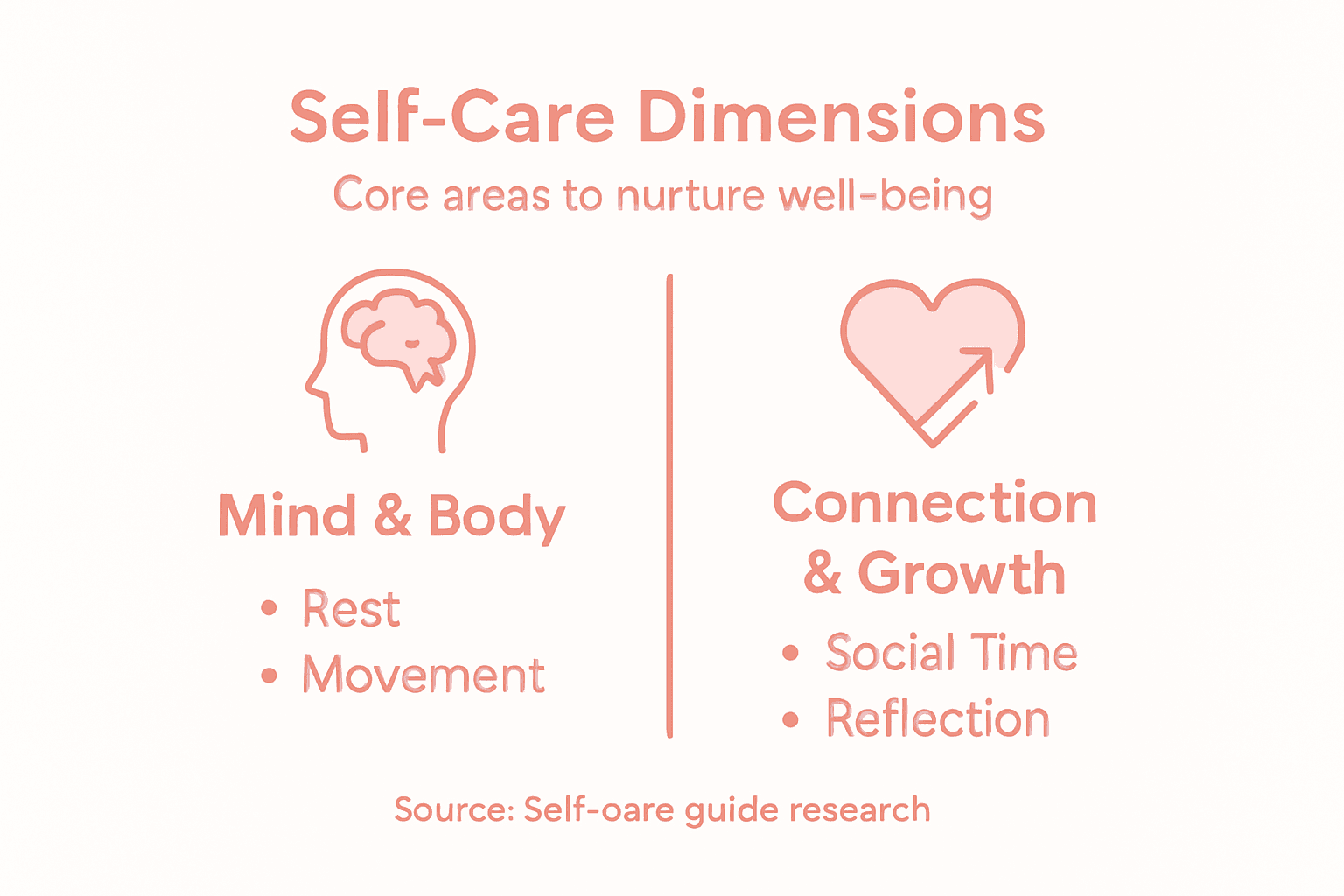
Building a personalized self-care routine means developing intentional strategies that genuinely support your mental and physical well-being. This step transforms your assessment insights into actionable, sustainable practices tailored specifically to your needs and lifestyle.
Start by developing realistic self-care strategies that align with your unique goals and energy levels. Focus on creating a routine that feels supportive rather than overwhelming:
Consider breaking down your routine into different wellness categories. This might include physical activities, emotional check-ins, stress management techniques, and personal growth opportunities. The key is creating a flexible framework that adapts to your changing needs.
Your self-care routine should feel nurturing, not restrictive.
Remember that consistency matters more than perfection. Some days will be easier than others, and that’s completely normal. Building a sustainable routine takes time, patience, and self-compassion.
Pro tip: Develop a simple tracking system like a digital or physical journal to monitor your self-care activities and adjust your routine based on what truly supports your well-being.
Mindfulness is a powerful technique for reducing stress and improving overall mental well-being. This step will help you integrate intentional practices that ground you in the present moment and create space for emotional healing and self-awareness.
Practicing mindfulness in daily life can transform how you experience stress and interact with your thoughts. Start by exploring simple techniques that fit seamlessly into your existing routine:
Begin with short, manageable practices that don’t feel overwhelming. The goal is consistency rather than perfection. You might start with just two minutes of focused breathing each morning or a brief meditation during your lunch break.
Mindfulness is a skill that develops with gentle, patient practice.
Remember that mindfulness isn’t about eliminating thoughts but observing them without judgment. Some days will feel easier than others, and that’s completely normal. The key is approaching these practices with curiosity and compassion.
Pro tip: Use smartphone apps or free online resources to guide your initial mindfulness practice, helping you build confidence and structure in your relaxation techniques.
Developing meaningful social connections is crucial for your overall mental and physical well-being. This step will help you intentionally cultivate relationships that support, inspire, and energize you through life’s challenges.
Understanding the health benefits of social connections reveals how powerful human relationships can be for your wellness. Start expanding your social network with these strategic approaches:
Quality matters more than quantity when building connections. Focus on relationships that feel genuine and mutually supportive. This might mean being selective about who you invest your emotional energy in and creating boundaries that protect your well-being.
Not every interaction needs to be deep – sometimes simple, consistent connections matter most.
Remember that building meaningful relationships takes time and vulnerability. Some connections will naturally evolve, while others might require more intentional effort. Be patient with yourself and others during this process.
Pro tip: Schedule regular social interactions like you would any other important commitment, ensuring you prioritize connection in your self-care routine.
Tracking your self-care journey helps you stay motivated, identify what works, and make meaningful adjustments. This step transforms your self-care routine from a static plan into a dynamic, responsive approach that grows with you.
Developing successful self-care strategies requires consistent reflection and honest evaluation. Use these methods to monitor your progress:
Think of your self-care plan as a living document that evolves with your needs. Some strategies might work brilliantly for a few weeks, then lose effectiveness. That’s completely normal and part of personal growth.
Progress isn’t linear – it’s a series of experiments and discoveries.
Be compassionate with yourself during this process. Not every week will look the same, and that’s okay. The goal is consistent effort, not perfection. Small, incremental changes often create the most sustainable improvements.
Compare different ways to track your self-care progress:
| Tracking Method | Ease of Use | Best For |
|---|---|---|
| Paper Journal | Very easy | Those who prefer writing by hand |
| Mobile App | Convenient | Users wanting reminders and data analysis |
| Spreadsheet | Customizable | People tracking detailed metrics |
| Visual Wall Chart | Highly visible | Individuals who benefit from visuals |
Pro tip: Use a digital or physical tracker with color-coding or simple symbols to make progress monitoring quick and visually engaging.
The challenges of building a personalized self-care routine and finding mindful ways to nurture emotional wellness can feel overwhelming. If you relate to the desire for progress over perfection and want support embracing consistent, sustainable habits like mindfulness and social connection, you are not alone. WomanEdit brings together inspiring stories, wellness insights, and real-life tips to empower modern women to enhance their well-being while staying engaged and uplifted.

Explore practical advice and uplifting content designed to help you tackle stress, fuel your mental health, and deepen your personal growth with confidence. Take the next step to improve your self-care by visiting WomanEdit and discovering our collection of empowering articles on lifestyle, mental health, and personal development. Start prioritizing yourself today with expert guidance and a community that understands your journey.
Start by reflecting on your current wellness habits and identifying areas that need improvement. Use a structured assessment worksheet to rate your physical, emotional, mental, and spiritual health practices to create a personalized strategy.
Begin by selecting 2-3 achievable self-care activities that resonate with you. Schedule these activities like important appointments, ensuring that your routine feels supportive and manageable.
Start with brief mindfulness practices, such as 5-10 minutes of breath meditation or mindful walking during breaks. The key is to practice consistently, as simple techniques help ground you in the present and reduce stress over time.
Meaningful social connections enhance your overall mental and physical well-being by providing support and inspiration during life’s challenges. Focus on nurturing genuine relationships that motivate you and make a conscious effort to reconnect or engage with people regularly.
Create a weekly check-in journal to document your self-care activities and reflect on your emotional patterns. Assess your energy levels and the completion of self-care activities to identify trends and adjust your plan as needed to support ongoing improvement.
Recognize that it’s normal for self-care strategies to fluctuate in effectiveness. If you notice a decline, consider reassessing your needs and experimenting with new activities or techniques that align better with your current state.
Article generated by BabyLoveGrowth
Source: Editorial Use | Image: Editorial Use